
Kindergarten Billing and Invoicing Software: A Professional Guide to School Finance
- Cyberland
- 16 hours ago
- 11 min read

What if the most persistent challenge in your school's daily operations isn't the classroom management, but the silent complexity of your monthly financial reconciliation? For many Singaporean educators, the transition from manual spreadsheets to a professional kindergarten billing and invoicing software represents more than just a technical upgrade; it's a commitment to operational excellence and institutional trust. Managing the intricacies of ECDA subsidies, MSF grants, and various PayNow transfers often leads to administrative bottlenecks that distract from your primary mission of early childhood development.
We understand that manual invoice errors and the subsequent parent disputes can strain the vital relationship between your center and the families you serve. This guide explores how a specialized financial system streamlines these workflows, ensuring that your school remains compliant with local regulations while providing absolute financial transparency. You'll discover the path to automated, error-free invoicing and learn how to generate audit-ready reports that simplify your year-end reviews.
Table of Contents
The Administrative Burden: Why Manual Kindergarten Billing Fails
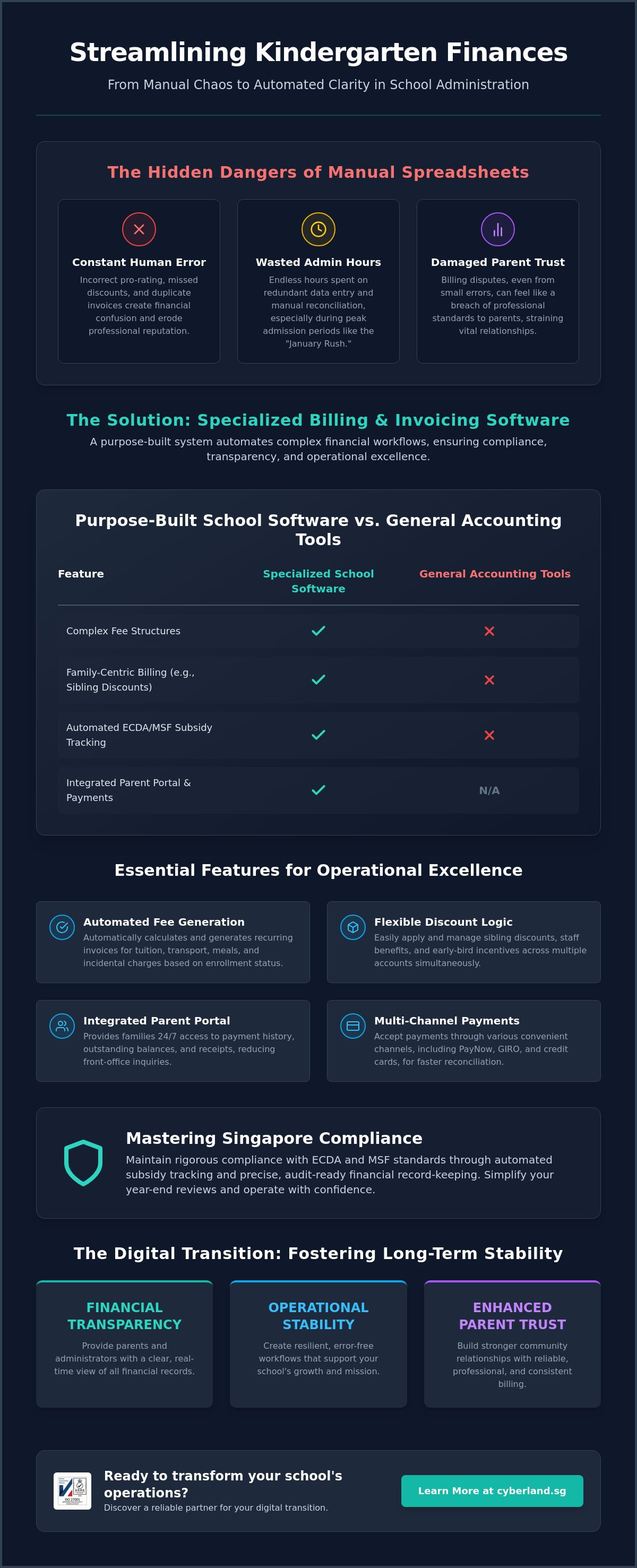
Efficient financial management serves as the structural backbone of any sustainable educational institution. Many school leaders initially rely on manual spreadsheets because they appear cost-effective, yet this reliance often creates a fragile foundation that risks more than just administrative hours. The hidden costs of these "free" tools manifest in lost revenue, hours of redundant data entry, and a persistent lack of real-time financial clarity. Transitioning to a professional kindergarten billing and invoicing software isn't merely a technical change; it's a strategic move from a reactive administrative stance to a proactive, growth-oriented leadership model.
Modern fee structures in Singapore have evolved beyond simple monthly tuition. Administrators must now juggle complex variables including transport fees, meal plans, and various incidental charges for enrichment materials or excursions. Without a centralized system, reconciling these disparate data points becomes a source of constant stress. This specialized administrative work is often a core component of a broader Student Information System (SIS), which serves as the definitive digital ledger for all student-related data and financial history. When these systems are fragmented, the risk of revenue leakage increases significantly.
Beyond the balance sheet, manual billing failures directly impact the relationship between the school and the family. In the early childhood sector, trust is the primary currency. A single billing dispute, while perhaps a simple clerical error in the eyes of the administrator, can feel like a breach of professional standards to a parent. Repeated errors in invoicing or difficulty in verifying payment statuses signal a lack of institutional discipline. This friction can overshadow even the most exceptional pedagogical achievements, as parents expect the same level of care in the school's business operations as they see in the classroom.
The Risk of Human Error in Tuition Invoicing
Manual reconciliation frequently leads to "ghost" overdue accounts where payments have been made but not correctly attributed. Common mistakes such as duplicated invoices, overlooked sibling discounts, or incorrect pro-rating for mid-month enrollments create unnecessary administrative churn. These errors don't just waste time; they erode your kindergarten's professional reputation and can lead to uncomfortable confrontations that are entirely avoidable with automated logic.
Operational Bottlenecks During Peak Admission Periods
The "January Rush" presents a unique challenge as administrators attempt to process hundreds of new enrollments, deposits, and insurance fees simultaneously. Administrative fatigue during these high-volume cycles often leads to compliance gaps in record-keeping and delayed billing cycles. The manual entry of hundreds of new student profiles and deposit records during the peak enrollment season creates a critical administrative bottleneck that delays revenue recognition and increases the likelihood of data entry errors.
Essential Features of Specialized Kindergarten Invoicing Software
High-performing educational institutions require financial tools that mirror the complexity of their daily operations. While general accounting platforms offer basic ledger functions, they often lack the nuanced logic necessary for early childhood centers. A robust kindergarten billing and invoicing software acts as a dedicated financial anchor; it automates the calculation of fees based on specific student enrollment statuses and program types. Whether a child is enrolled in a half-day nursery program or a full-day kindergarten track, the system ensures that every invoice reflects the correct tuition rate without manual intervention.
Precision in billing extends beyond base tuition to include sophisticated discount logic. Administrators need the flexibility to apply sibling discounts, staff benefits, or early-bird registration incentives across hundreds of accounts simultaneously. Modern systems also provide integrated parent portals, where families can access their payment history and download receipts at their convenience. This level of transparency reduces the administrative burden on your front-office staff. When parents can verify their own records and pay via multi-channel support like PayNow, GIRO, or credit cards, the friction in your accounts receivable process disappears.
Automated Recurring Billing and Installment Plans
Consistency is the foundation of a healthy cash flow. Professional software allows you to set up term-based or monthly billing cycles that run automatically, ensuring invoices reach parents on a predictable schedule. These systems treat registration fees and security deposits as distinct financial entities, keeping them separate from operational tuition. Automated reminders further support this process by gently prompting parents before a due date, which significantly reduces the volume of overdue accounts without requiring a single phone call from your staff.
Integrated Student Information System (SIS) Connectivity
Financial data shouldn't exist in a vacuum. Effective billing software must communicate directly with your attendance and enrollment records to ensure a single source of truth. This connectivity allows the system to automatically adjust fees based on mid-term entries or specific withdrawal dates. It's particularly vital when calculating net fees after subtracting Singapore's official preschool subsidies, as the software can track which families qualify for specific MSF or ECDA grants. This integration ensures that your financial records are always audit-ready and reflective of your current student population.
Implementing these specialized features provides a level of operational discipline that generic tools simply cannot match. If you're looking to enhance your school's financial maturity, exploring a tailored Kindergarten Management System can provide the stable foundation your institution needs to grow.
Purpose-Built School Billing vs. General Accounting Software
A common misconception in school administration is that a standard business accounting tool can effectively manage educational finances. While platforms like Xero or QuickBooks excel at general ledger management, they often struggle with the multi-dimensional nature of school fees. A specialized kindergarten billing and invoicing software is designed around the unique hierarchy of an educational institution; it recognizes that your primary data unit is a "family" rather than a singular "customer." This distinction is critical when applying sibling discounts or managing varied subsidies across different children within the same household.
Government subsidies and scholarship deductions add layers of complexity that general software isn't equipped to handle natively. In the Singaporean context, tracking MSF or ECDA grants requires a system that can subtract these values before generating the final parent invoice. General tools typically require manual workarounds for these deductions, which increases the risk of calculation errors. Beyond these financial mechanics, educational data requires higher protection standards. A purpose-built system ensures that sensitive student information remains secured behind protocols specifically designed for the education sector, aligning with local data privacy expectations under the PDPA.
The Complexity of Educational Fee Structures
Generic accounting tools often falter when schools need to process incidental charges like field trips, uniform sales, or meal plan adjustments for specific student groups. Bulk invoicing in these systems assumes a uniform product delivery, which rarely applies to a dynamic classroom environment. Singaporean kindergartens also require specific non-GST invoice templates if they haven't crossed the GST registration threshold. Specialized software provides these templates natively, ensuring that your financial documentation remains professional and compliant with local accounting standards without requiring custom design work for every bill.
Parent Experience and Communication Workflows
The professionalism of your center is reflected in the clarity of your communication. Branded, itemized invoices help parents understand exactly what they're paying for, which reduces the volume of inbound queries to your admin office. When parents use a self-service portal to download tax-compliant receipts or check their balance, it empowers them and saves your staff hours of manual retrieval work. This seamless digital experience builds institutional trust; it positions your kindergarten as a modern, well-managed partner in their child's development rather than just a service provider.
Navigating Compliance and Subsidy Management in Singapore
Operating a preschool in Singapore requires more than just educational passion; it demands rigorous adherence to national standards set by the Early Childhood Development Agency (ECDA). Financial record-keeping is a critical pillar of these standards, yet the manual tracking of government grants often becomes an administrative minefield. Utilizing a specialized kindergarten billing and invoicing software allows school leaders to automate the complex math behind national subsidies, ensuring that every cent is accounted for and every parent's bill is accurate. This digital discipline is essential for maintaining the institutional integrity required for licensing renewals and regulatory reviews.
The complexity of the Singaporean subsidy landscape is significant. For Singapore Citizen children in ECDA-licensed centers, working mothers are eligible for a basic subsidy of S$300 for childcare or S$600 for infant care. Families with a gross monthly household income of S$12,000 or less may qualify for an Additional Subsidy, which can reach up to S$467 for childcare. Managing these variables manually for a diverse student population isn't just time-consuming; it's a risk to your center's compliance status. Professional software handles these calculations natively, subtracting the correct amounts based on the applicant's working status and verified income levels before the invoice ever reaches the parent's inbox.
Managing Government Subsidies for Families
Precision in grant management prevents the billing discrepancies that often lead to parent disputes. A robust system tracks subsidy eligibility periods automatically, ensuring that deductions don't accidentally continue after a child's status changes or a grant expires. Implementing a system that automatically updates and tracks subsidy disbursements is essential for maintaining ECDA compliance as regulatory reporting requirements become more digitized in 2026. This automation ensures that lower-income families, particularly those with a household income of S$6,000 and below who are eligible for maximum subsidies, receive their entitlements without administrative delay.
Data Security and Regulatory Discipline
Protecting student financial records is a legal mandate under the Personal Data Protection Act (PDPA). Secure, Singapore-based servers play a vital role in this, providing a localized and protected environment for sensitive family data. A professional billing system maintains a transparent, permanent audit trail for every transaction, from the initial registration fee to the final monthly tuition payment. This level of detail helps schools stay current with evolving MSF reporting standards, providing a clear window into the school's financial health during any external audit or regulatory inspection.
Achieving this level of regulatory precision requires a partner who understands the local landscape. You can ensure your center meets these rigorous standards by adopting a Singapore-compliant PreSchool Management System designed for institutional stability and growth.
BridgED: A Reliable Partner for Your School’s Digital Transition
Transitioning to a new digital infrastructure requires a partner who understands the weight of educational responsibility. Cyberland’s BridgED platform was built specifically to address the unique needs of Singaporean preschools, providing a stable environment where administrative efficiency and pedagogical excellence coexist. Our philosophy of "quiet confidence" is rooted in decades of expertise, ensuring that our kindergarten billing and invoicing software delivers reliability without the distractions of flashy marketing hype. We don't just provide a tool; we offer a sophisticated guide through the complexities of technological modernization.
One of the most significant barriers to adopting new systems is the fear of a disruptive migration process. We recognize that moving from legacy systems or manual spreadsheets involves high stakes for your center’s financial continuity. As bridge-builders, we facilitate a methodical transition that prioritizes data integrity and staff readiness. Our team manages the heavy lifting of data migration, ensuring that your historical financial records and student profiles are preserved and accurately reflected in the new system. This deliberate approach fosters a sense of transparency and trust from the first day of implementation.
The BridgED Advantage for Kindergarten Administration
BridgED offers a unified ecosystem where billing, attendance, and parent communication are naturally linked. This integration ensures that a child’s presence in the classroom is directly reflected in their financial account, reducing the need for manual cross-referencing. The localized features are designed specifically for Singaporean regulatory frameworks, including the automated tracking of subsidies and compliance reporting mentioned in previous sections. This level of professional discipline matches the prestige of your educational institution, providing parents with a polished and reliable digital experience that commands respect.
Customization and Long-Term Stability
Every school has unique institutional needs that a one-size-fits-all solution might not fully address. Beyond our standard PreSchool Management System, we offer custom software development to tailor the platform to your specific workflows. This bespoke approach ensures that the software grows with your school rather than forcing your school to adapt to the software’s limitations. We provide ongoing engineering support to ensure long-term stability, acting as a dependable mentor throughout your center’s digital journey. By choosing a partner dedicated to the early childhood sector, you're investing in a stable, sophisticated future for your school's administration.
Discover how BridgED can transform your kindergarten operations and provide the financial clarity your institution deserves.
Advancing Your School's Financial Maturity
Securing the financial future of an educational institution requires a shift from fragmented manual processes to a unified, digital ecosystem. By implementing a specialized kindergarten billing and invoicing software, you eliminate the administrative bottlenecks that hinder growth and erode parent trust. The distinction between general accounting tools and purpose-built systems like BridgED is fundamental to maintaining ECDA compliance and managing complex Singaporean subsidy frameworks accurately. This transition isn't merely about efficiency; it's about establishing a legacy of operational excellence.
Cyberland has served as a dedicated Singapore-based software provider since 2002, building a proven track record with local preschools and social agencies. Our BridgED platform is specifically engineered to support the nuanced needs of Singaporean educators, ensuring your center remains audit-ready and professional in every interaction. We invite you to Request a Professional Consultation for Your Kindergarten Management System to see how our expertise can support your school’s long-term stability. Embracing this modernization will allow your team to focus on what matters most: the development and well-being of the children in your care.
Frequently Asked Questions
Is kindergarten billing software different from standard accounting tools?
Specialized kindergarten billing and invoicing software differs from standard tools by prioritizing family-centric data structures rather than simple vendor-customer relationships. While general accounting software manages basic transactions, our system links billing directly to student enrollment, program types, and classroom attendance records. This integration allows for more nuanced financial management that mirrors the daily realities of a Singaporean educational environment.
How does the software handle ECDA and MSF subsidies in Singapore?
The software automates the calculation of Singapore's specific subsidy frameworks by subtracting basic and additional grants directly from the gross tuition fee. It recognizes the correct rates, such as the S$300 monthly basic childcare subsidy for working mothers, based on the student's eligibility profile. This ensures that the final invoice reflects the accurate net amount payable by the parent while maintaining a clear record for ECDA audits.
Can parents pay tuition fees via PayNow or GIRO through the system?
Yes, our system fully supports PayNow, GIRO, and credit card payments to streamline your center's collections. Providing these multi-channel options reduces the administrative burden of manual bank transfer reconciliation and speeds up the accounts receivable cycle. Parents can settle their accounts through their preferred mode and receive an automated, tax-compliant receipt immediately through the integrated parent portal.
Is student and financial data secure under Singapore’s PDPA regulations?
Data security is managed through secure, localized servers that strictly adhere to Singapore’s PDPA regulations. We implement rigorous encryption and role-based access controls to protect sensitive student records and family financial history. This disciplined approach ensures that your institution maintains the highest standards of confidentiality and regulatory compliance throughout its digital operations.
Can the software manage different fee structures for siblings or staff?
Our software manages complex fee structures through automated discount logic that applies relevant deductions without manual intervention. It recognizes sibling relationships and staff affiliations within the database, ensuring that your kindergarten billing and invoicing software remains accurate across diverse student profiles. This automation prevents the common clerical errors that often lead to parent disputes during the billing cycle.
What happens to our old financial records when we switch to BridgED?
When you transition to BridgED, our engineering team facilitates a thorough data migration process to preserve your historical continuity. We securely transfer your legacy financial records and student profiles into the new system, acting as a bridge-builder between your old workflows and modern technology. This methodical approach ensures that your school doesn't lose vital data or audit trails during the transition.
Does the software generate non-GST invoices for educational services?
The system includes native non-GST invoice templates specifically designed for Singaporean kindergartens that aren't GST-registered. This allows you to generate professional, itemized bills that meet local accounting standards and IRAS requirements for non-registered entities. Having these templates built-in ensures your financial documentation remains clear and professional without requiring manual adjustments for every billing cycle.
How long does it take to implement a new kindergarten management system?
Implementation typically follows a steady, phased timeline that prioritizes accuracy and staff readiness over mere speed. While the specific duration depends on the complexity of your existing records, we focus on a deliberate rollout that includes data verification and comprehensive training. This unhurried pace ensures a stable transition that minimizes disruption to your daily school operations and fosters long-term institutional trust.


Comments