
Kindergarten Operations Management: A Comprehensive Reference Guide for 2026
- Cyberland
- Jun 28
- 11 min read

With the early childhood workforce reaching 25,000 professionals in 2025, the scale of the sector has never been greater, yet many leaders still feel isolated by the weight of administrative demands. You likely recognize that managing a center involves more than just curriculum planning. It's a constant balancing act between nurturing young minds and satisfying rigorous ECDA standards. The anxiety of audit readiness and the friction of disjointed parent communication can often overshadow your primary mission of education. This guide provides a strategic framework for kindergarten operations management designed to transform these pressures into a streamlined system of operational excellence.
We've developed this reference to help you master the complexities of modern administration with quiet confidence. You'll find a clear roadmap for improving efficiency and ensuring your center meets the latest Singaporean regulatory requirements. We'll explore how to reduce the administrative burden on educators, allowing them to focus on what matters most: the growth and development of the children in their care. By aligning your daily processes with professional standards, you can build a stable foundation for long-term success.
Table of Contents
Understanding Kindergarten Operations Management in the Modern Era
Effective kindergarten operations management serves as the structural foundation upon which educational excellence is built. In 2026, the sector has moved beyond the era of fragmented manual ledgers and isolated spreadsheets. Today, operational success is defined by a seamless synthesis of people, processes, and technology. This integration ensures that the administrative machinery of a center functions with precision, allowing the educational mission to remain the primary focus. When systems are robust, educators feel supported rather than encumbered by bureaucratic requirements. It creates a feeling of momentum where every staff member understands their role within the larger organizational machine.
Operational stability isn't a secondary concern but a prerequisite for high-quality pedagogy. Well-documented Early childhood education theories emphasize the importance of a secure, organized environment for learning. Without operational rigor, even the most innovative curriculum will falter under the weight of administrative inconsistency. The Centre Director must therefore act as a strategic operations leader, balancing the nuances of child development with the demands of corporate-standard governance. This shift in perspective allows leaders to view compliance not as a hurdle, but as a benchmark for excellence. By prioritizing operational health, a Director ensures that their center remains competitive and resilient in an evolving market.
The Scope of Early Childhood Operations
While classroom management focuses on the immediate interactions between teachers and students, school-wide operations address the broader infrastructure that makes those interactions possible. This distinction is critical for long-term stability. Efficient operations directly influence teacher retention; when staff don't have to struggle with broken processes or redundant data entry, their risk of burnout decreases significantly. Professional leadership thrives on quiet confidence, which is only achievable when every administrative component is reliable and predictable. This predictability fosters a culture of trust where educators feel their time is respected and their professional contributions are valued.
The Evolution of Management Systems
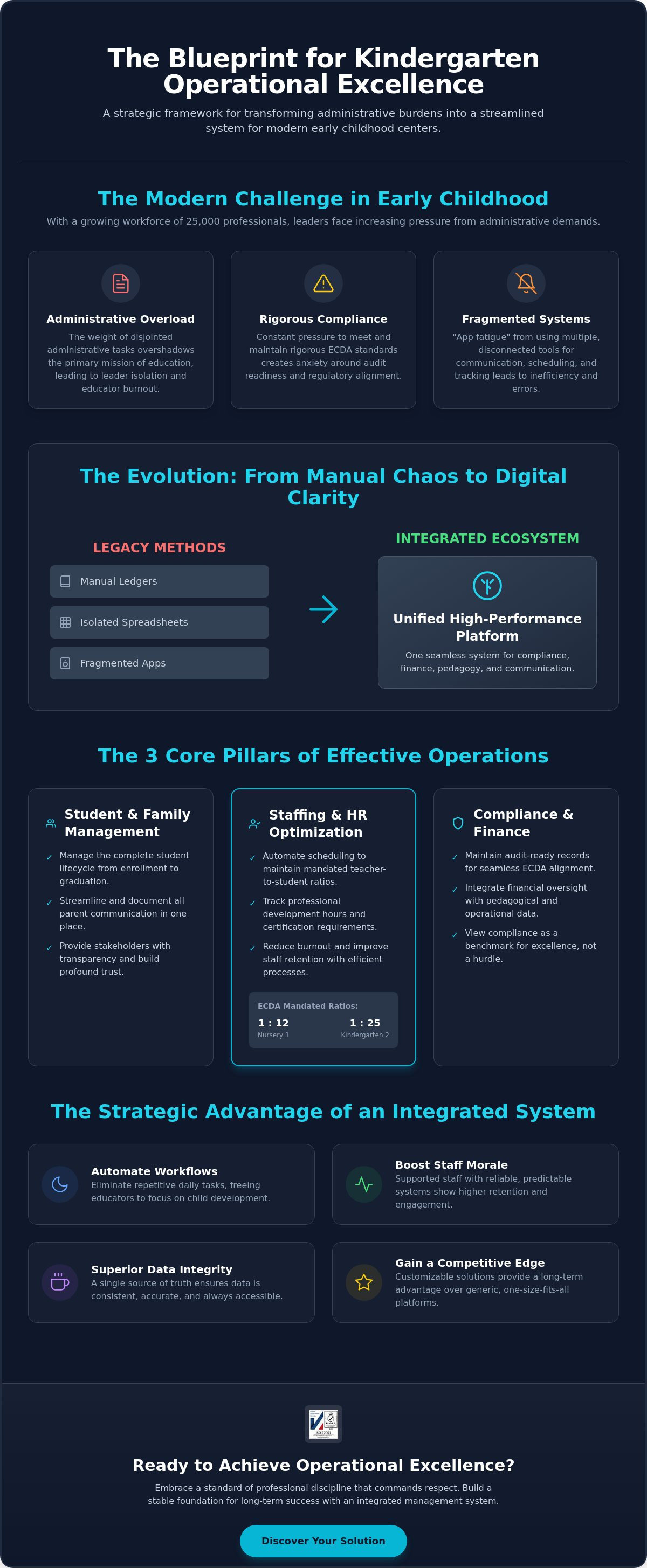
The journey toward modernization has seen centers transition from fragmented digital files to unified platforms like BridgED. For 2026, kindergarten operations management is a holistic framework that integrates regulatory compliance, financial oversight, and pedagogical tracking into a single, high-performance ecosystem. This digital evolution does more than just save time; it builds profound trust with stakeholders. Parents, investors, and regulators now expect a level of transparency and data integrity that only sophisticated, integrated systems can provide. Moving away from legacy methods isn't just about adopting new tools, it's about embracing a standard of professional discipline that commands respect across the industry.
The Core Pillars of Effective Kindergarten Operations
A resilient center relies on the strength of its internal infrastructure. High-level kindergarten operations management ensures that administrative precision supports, rather than hinders, the educational experience. By treating staffing, finance, and data as integrated pillars, leaders create an environment where excellence becomes a standard. This approach prevents the common pitfall of separating classroom pedagogy from the business functions that sustain it. When these elements work in harmony, the center projects a sense of quiet confidence that parents and staff can feel.
Staffing and Professional Development
Managing a workforce in early childhood requires more than just filling shifts. It involves maintaining precise teacher-to-student ratios as mandated by Singapore's Regulatory Landscape. For instance, ensuring a 1:12 ratio for Nursery 1 or 1:25 for Kindergarten 2 requires dynamic scheduling that accounts for leave and peak enrollment hours. Automating the tracking of professional development hours is equally vital. It ensures every educator meets their certification requirements without the need for manual oversight. When internal communication is streamlined, it fosters a culture of transparency that naturally reduces staff turnover and improves morale.
Financial Management and Subsidy Tracking
Financial sustainability is often the most complex pillar to manage within the sector. Centers must accurately process various Singaporean government subsidies, such as those for Anchor and Partner operators, while maintaining clear records for parents. Utilizing specialized kindergarten billing and invoicing software allows for the seamless integration of fee offsets and automated reminders. This reduces the burden of chasing late payments and ensures the center's cash flow remains stable. A professional financial system reflects the center's commitment to reliability, which in turn builds long-term parent trust.
Student Enrollment and Data Lifecycle
Managing a child's journey from the initial enquiry to graduation requires a unified data strategy. Centralizing waitlist management allows for better conversion rates and more accurate enrollment forecasting for the coming years. It's essential to maintain a "one source of truth" for critical student information, particularly health records and allergy details. This data must be protected in strict accordance with PDPA guidelines to ensure privacy and compliance. By digitizing this lifecycle, you create a professional communication loop that enhances brand loyalty. If you're looking to refine these processes, exploring a Kindergarten Management System can provide the necessary framework for this digital transition.
Navigating Singapore’s Regulatory Landscape and Compliance
In Singapore, regulatory adherence is more than a legal obligation; it's a testament to a center's commitment to professional integrity. The Early Childhood Development Agency (ECDA) acts as the primary regulator, establishing the operational standards that define high-quality care. For community-based centers or social agencies, managing Ministry of Social and Family Development (MSF) requirements introduces additional layers of administrative responsibility. Successful kindergarten operations management requires a proactive stance toward these regulations, moving from reactive "crisis mode" during audits to a state of constant readiness. It's about building a culture where precision is the default setting.
Maintaining audit-ready records across attendance, health checks, and incident reports is a significant undertaking that requires absolute accuracy. A center's ability to produce detailed documentation on demand reflects its overall organizational health and reliability. Utilizing a school management platform for kindergartens allows centers to automate the collection of this data, transforming a once-burdensome task into a streamlined digital process. This transition ensures that compliance isn't a separate, stressful activity but is woven into the fabric of daily operations. When the system handles the heavy lifting of data capture, leadership can focus on strategic growth.
ECDA Licensing and Quality Assurance
Securing and renewing an ECDA license requires a meticulous approach to record-keeping. The Singapore Pre-school Accreditation Framework (SPARK) sets even higher operational requirements for centers seeking to demonstrate excellence through voluntary certification. Digital systems provide the essential "paper trail" needed for these licensing renewals, offering a transparent and verifiable view of center activities over time. By automating the collection of evidence for quality rating scales, centers can focus on pedagogical improvements rather than manual data gathering. This methodical approach fosters a sense of stability that regulators and parents alike deeply respect.
Health, Safety, and Emergency Protocols
Safety remains the cornerstone of any early childhood environment, necessitating rigorous daily protocols. Digital health screening tools now allow for the automation of temperature checks and visual inspections, ensuring that health data is captured accurately and stored securely for future reference. In the event of an emergency, staff must have instant accessibility to contact databases through a centralized and secure system. By digitizing these daily logs, automated record-keeping reduces human error during ECDA audits, ensuring that every entry is timestamped and verifiable. This level of precision protects both the children and the center's reputation, building lasting trust through demonstrated discipline.
Best Practices for Streamlining Daily Kindergarten Workflows
Modern operational excellence is defined by the elimination of repetitive manual tasks that distract from the core mission of early childhood care. A sophisticated approach to kindergarten operations management prioritizes a software-first strategy, focusing on the essential triad of teacher, parent, and child. By replacing outdated sign-in sheets with automated attendance tracking, centers can capture real-time data that is both accurate and instantly accessible for safety audits. This shift doesn't just save time; it establishes a professional standard of precision that resonates throughout the entire organization.
Developing a systematic approach to incident reporting is equally vital for maintaining a secure environment. When a standardized digital framework is used, staff can log observations and follow-up actions immediately, ensuring that no detail is overlooked. Furthermore, utilizing data analytics allows leadership to move from reactive management to predictive planning. By analyzing historical data, directors can forecast enrollment trends and adjust staffing needs well in advance, ensuring the center remains resilient as the early childhood workforce continues to grow toward the projected demand of 3,500 additional educators by 2030.
Optimising Teacher Portals
Reducing administrative friction is the most effective way to support your teaching staff. When teachers have access to a centralized portal for digital lesson planning and portfolio creation, they save hours of manual work that can be redirected toward pedagogy. Real-time observation logging allows for the immediate capture of developmental milestones, ensuring that every child’s progress is documented with care. This methodical approach fosters a culture of transparency and respect, where educators feel empowered by the tools they use rather than burdened by them.
Enhancing the Parent Experience
Building brand loyalty in 2026 requires a professional communication loop that avoids the common pitfall of "app fatigue." Centralizing all parent interactions through a dedicated, secure portal ensures that families receive real-time updates on their child’s day without searching through disjointed channels. Whether it's simplifying fee payments or facilitating digital document submissions, mobile-friendly interfaces provide the convenience that modern parents expect. This transparency builds a strong sense of community and trust, positioning your center as a dependable partner in their child's developmental journey. To see how these workflows can be integrated into your center, explore our Kindergarten Management System.
The Strategic Advantage of an Integrated Management System
Selecting the right technological foundation is a critical decision that determines the long-term agility of an educational institution. While off-the-shelf software might offer a quick fix, it often lacks the nuanced flexibility required to navigate the specific complexities of the Singaporean preschool sector. Highly customizable or bespoke solutions provide a superior advantage by aligning perfectly with your center's unique workflows and pedagogical goals. This alignment ensures that your kindergarten operations management system acts as an enabler of growth rather than a rigid constraint. By investing in a platform that adapts to your needs, you secure a foundation that supports both administrative precision and educational innovation.
Transitioning from legacy manual processes to a digital ecosystem requires a methodical and intentional approach. It isn't merely about replacing paper with screens; it's about a fundamental digital transformation that enhances data integrity and stakeholder trust. Our philosophy centers on acting as a bridge-builder between sophisticated technology and the earnest mission of early childhood education. At the heart of this transition is BridgED, which serves as the operational engine for the modern center. This platform integrates every administrative pillar into a single, cohesive interface, allowing leadership to manage their centers with a sense of quiet confidence and professional discipline.
Choosing the Right Technology Partner
A successful digital transition depends heavily on the expertise of your technology partner. It's vital to evaluate providers based on their local experience and deep understanding of Singapore's regulatory environment. A partner who understands the intricacies of ECDA requirements can offer insights that generic global vendors cannot. Scalability is another essential factor; your system must be capable of growing alongside your center without requiring a complete overhaul. Local support and the capacity for custom software development are indispensable for meeting unique institutional needs, ensuring that your system remains relevant and reliable as the industry evolves.
The Future of Kindergarten Operations
The next frontier of kindergarten operations management lies in the strategic use of predictive analytics and intelligent automation. We're moving toward an era where data can help predict student outcomes and optimize operational budgeting with unprecedented accuracy. AI will play an increasingly sophisticated role in personalizing parent communication and automating repetitive administrative tasks, further reducing the burden on educators. Ultimately, the goal of these technological advancements is to protect the "joy of learning." By achieving operational excellence, we clear the path for teachers and students to focus on the meaningful connections that define the best early childhood experiences.
Building a Sustainable Future for Early Childhood Education
Achieving operational excellence is a strategic journey that requires both a visionary outlook and a reliable technical infrastructure. By mastering the core pillars of kindergarten operations management, you ensure that your center remains a stable, nurturing environment where both educators and children can thrive. We've discussed how streamlining workflows and maintaining rigorous compliance with ECDA and MSF standards builds a foundation of trust with families and regulators alike. This professional discipline allows you to focus on the essential mission of education without being hindered by administrative complexity.
As you look toward the future, choosing a partner with deep local roots is essential for navigating the evolving landscape. Trusted by Singaporean educational institutions since 2002, we provide tailored software solutions that align with your unique school workflows and specialized regulatory standards. Discover how BridgED can transform your kindergarten operations and provide the sophisticated framework your center deserves. We're here to support your transition toward a more efficient and mission-driven future where the joy of learning remains the primary focus.
Frequently Asked Questions
What exactly is included in kindergarten operations management?
It encompasses the strategic integration of all administrative functions, including human resources, student data lifecycle management, financial oversight, and regulatory compliance. This framework serves as the infrastructure that supports daily activities like automated attendance tracking, health screenings, and centralized parent communication. By unifying these disparate tasks, centers ensure that their educational mission is supported by a stable and predictable foundation that commands respect from all stakeholders.
How does an operations management system help with ECDA compliance?
These systems automate the collection and storage of audit-ready records, such as temperature logs, incident reports, and teacher-to-student ratios. By providing a verifiable digital paper trail, centers ensure they meet the specific licensing standards set by the Early Childhood Development Agency (ECDA) without manual record-keeping errors. This constant state of readiness simplifies the license renewal process and provides peace of mind during unannounced inspections by regulatory authorities.
Can small kindergartens benefit from operations management software?
Yes, smaller centers often gain the most from automation because they typically operate with leaner administrative teams. Implementing a kindergarten operations management framework allows small center directors to reclaim time spent on repetitive paperwork and focus on curriculum quality and community building. Scalable digital solutions ensure that even modest operations can maintain the same high professional standards as larger anchor operators while reducing the risk of administrative burnout.
What are the most common operational challenges for Singaporean preschools?
Singaporean preschools frequently struggle with "app fatigue" from disjointed communication channels, the heavy administrative burden of manual subsidy tracking, and the pressure of maintaining strict teacher-to-student ratios. Managing the workforce is another significant hurdle, as the industry projects a need for 3,500 more educators by 2030. Integrated systems address these issues by centralizing data and automating complex financial calculations required for various government fee offsets and subsidies.
How do digital portals improve parent-teacher communication?
Digital portals improve communication by providing a single, secure channel for real-time updates, child portfolios, and fee payments. This centralization eliminates the need for multiple messaging apps and ensures that parents receive consistent, professional information directly from the center. It builds a stronger sense of partnership and transparency, which is essential for fostering long-term brand loyalty and trust among modern, tech-savvy families who value efficiency.
Is it difficult to migrate student records from paper to a digital management system?
The transition from paper to digital is a methodical process that is entirely manageable with the right technology partner. While the initial data entry requires precision, modern systems are designed to facilitate smooth record migration through structured templates and professional support. Once legacy data is digitized, centers benefit from "one source of truth" for student health and enrollment records, which significantly reduces administrative friction and improves data security.
How does operational efficiency impact teacher retention?
Operational efficiency reduces the non-teaching workload, which is a primary driver of educator burnout and turnover in the sector. When teachers have access to automated lesson planning and digital observation tools, they can dedicate more energy to pedagogy and child interaction rather than manual paperwork. A center that values its staff's time by providing reliable administrative systems fosters a more supportive, professional culture that encourages long-term career commitment.
What should I look for when selecting a kindergarten management system in Singapore?
You should prioritize a system that demonstrates deep knowledge of the local regulatory landscape, specifically ECDA and MSF requirements. Look for a partner that offers customizable software development and local support rather than generic global templates. Essential features include integrated billing for Singaporean subsidies, robust data security aligned with PDPA guidelines, and a scalable architecture that can grow alongside your center's enrollment and evolving institutional needs.


Comments