
The 2026 Preschool Software Implementation Plan: A Guide for Singaporean Centres
- Cyberland
- Jun 27
- 12 min read

By 2026, the margin for administrative error in Singaporean preschools has effectively vanished under the weight of the 5th Edition ECDA Code of Practice. You likely recognize the mounting pressure of manual documentation and the persistent anxiety that accompanies an impending audit. It's a common challenge to balance the rigorous demands of MSF subsidy management with a team that may be hesitant to abandon familiar, albeit inefficient, paper-based routines.
At Cyberland, we understand these challenges. This article serves as your definitive guide to developing a robust preschool software implementation plan for Singaporean centres, one they can rely on for a seamless digital transition. We'll outline a strategic roadmap to replace cumbersome manual workflows with a sophisticated, paperless ecosystem that prioritizes regulatory compliance. You'll learn how to achieve high staff adoption rates and master the nuances of the Refreshed Early Childhood Industry Digital Plan (IDP 2.0). We'll also examine how to leverage available funding, such as the Early Childhood Digitalisation Grant, to ensure your centre's modernization is both operationally sound and fiscally responsible.
Table of Contents
Understanding the Singaporean Preschool Digital Landscape in 2026
The modern early childhood centre is no longer merely a physical space for supervision; it's a sophisticated operational environment where digital infrastructure plays a pivotal role. A robust Preschool Management System (PMS) functions as the centralized administrative and pedagogical hub, integrating everything from enrollment to curriculum planning. As Singapore advances its "Smart Preschool" initiative, the transition from fragmented manual records to a unified digital ecosystem is a requirement for long-term sustainability. Relying on legacy manual record-keeping introduces significant vulnerabilities, including data fragmentation and compliance risks during ECDA audits. In contrast, cloud-based systems offer a secure, scalable foundation that enables a data-driven approach to child development. Within any comprehensive preschool software implementation plan singapore centres must account for this shift from simple automation to evidence-based decision-making.
The Impact of the IDP 2.0 Refresh
The announcement of the Refreshed Early Childhood Industry Digital Plan (IDP 2.0) in March 2026 marked a significant evolution in the sector's technological standards. This update moves beyond basic digitalization, introducing requirements for AI-enabled solutions that assist with predictive scheduling and personalized learning observations. These 2026 standards prioritize educator productivity, ensuring that teachers spend less time on repetitive data entry and more time on child nurturing. Choosing a technology provider aligned with these evolving standards is critical for maintaining eligibility for grants like the ECDG. Integrating advanced educational technology isn't just about modernization; it's about adhering to a national vision of excellence.
Stakeholder Alignment: From Principals to Parents
Successful digital transformation requires a shared vision across all levels of the organization. Principals benefit from strategic oversight and automated financial reporting, which allows for more precise budget management and subsidy reconciliation. For teachers, a well-implemented system reduces the "administrative tax," freeing them to focus on classroom pedagogy and meaningful student interactions. Parents also experience a shift in their relationship with the centre. Real-time communication and secure fee payment portals build a layer of transparency and trust that is difficult to achieve with paper-based systems. This alignment ensures that the transition is viewed as a collective advancement rather than a top-down imposition. When stakeholders understand how the new system solves their specific pain points, adoption rates naturally climb.
Essential Features for Regulatory Compliance and Operational Excellence
A successful transition to digital systems relies on selecting features that address the specific regulatory rigour of the Singaporean market. Automated health checks and attendance tracking aren't just conveniences; they're critical tools for ensuring child safety and maintaining compliance with the latest health protocols. By digitizing these daily touchpoints, centres eliminate the risk of missing entries or illegible handwriting that often complicates manual logs. Within your preschool software implementation plan singapore centres must prioritize systems that provide real-time visibility into these data points, ensuring that every child's presence and wellbeing is accounted for with high precision.
Navigating ECDA and MSF Requirements
Compliance is the cornerstone of any licensed centre's operations. The Early Childhood Development Agency (ECDA) requires meticulous record-keeping for licensing renewals, and a digital system ensures these records are always audit-ready. Modern platforms must also handle the complexities of MSF subsidy verification. With full-day childcare basic subsidies reaching up to S$300 for working mothers, and additional subsidies scaled based on household income, manual calculations are prone to error. A sophisticated system automates these claims, ensuring that your centre receives the correct disbursements while remaining fully PDPA-compliant. Managing sensitive student information requires a secure, encrypted environment to protect family privacy and adhere to national data protection standards.
Financial Automation and Reporting
Operational excellence is often measured by the efficiency of a centre's financial workflows. Integrating billing modules that support PayNow and GIRO gateways allows for a seamless collection process, reducing the administrative burden on your finance team. This is particularly vital when managing government-mandated fee caps, which for 2026 are set at S$610 for Anchor Operators and S$650 for Partner Operators. Generating real-time financial audits provides principals with the strategic oversight needed to manage cash flow and operational costs effectively. For those seeking to unify their operations, exploring custom software development can help integrate staff payroll and leave management into the same administrative ecosystem, creating a single source of truth for all centre data.
Pedagogical quality is equally supported by digital tools. Teacher portals designed for lesson planning and task management allow educators to align their activities with the Nurturing Early Learners (NEL) framework. Digital e-portfolios enable teachers to capture learning milestones through photos and observations, which can then be shared instantly with parents. This not only enhances engagement but also provides a structured, chronological record of a child's development. By reducing the time spent on manual documentation, teachers can dedicate more energy to classroom pedagogy and individual child support, which remains the primary mission of any early childhood educator.
Evaluating Off-the-Shelf vs. Custom Software Solutions
Choosing the right architecture is a critical step in any preschool software implementation plan singapore operators undertake. For many, a standard SaaS solution provides the necessary framework to manage daily operations with professional precision. These platforms are designed to handle the core requirements of the local market, such as attendance tracking and MSF subsidy management. Yet, as a centre grows or specializes, the limitations of off-the-shelf software can become apparent. This is often the point where leadership must decide between adapting their workflows to fit a generic tool or commissioning a system that fits their unique vision. The decision isn't merely technical; it's a strategic choice about how your centre will scale in a competitive landscape.
The long-term ROI of bespoke engineering often surprises those who initially favour recurring subscription models. While SaaS platforms offer a lower entry cost, the cumulative expense of per-student monthly fees can eventually exceed the investment of a custom-built system over several years. Additionally, custom solutions eliminate the "feature bloat" common in mass-market software, providing a streamlined interface that includes only what your staff actually needs. Smaller centres shouldn't be deterred by the perceived complexity. Often, a focused custom module is the most straightforward way to solve a persistent operational hurdle without the compromises required by a one-size-fits-all package.
Bespoke Engineering for Unique Educational Philosophies
Standard software often struggles to capture the nuances of specialized pedagogical approaches like Montessori or Reggio Emilia. These philosophies require specific observation metrics and portfolio structures that a generic system might lack. As the National Institute of Education (NIE) notes, it's essential to prepare children for online learning and confident tool usage, which starts with a digital environment that mirrors the school's unique values. Custom Software Development allows for the integration of legacy databases and unique curriculum workflows, ensuring that your digital transition doesn't result in data silos or pedagogical compromises.
The PSG Grant Landscape in 2026
Navigating the financial aspect of digitalization is significantly easier when leveraging available government support. In 2026, the Early Childhood Digitalisation Grant (ECDG), operating under the Productivity Solutions Grant (PSG) framework, provides funding for up to 50% of implementation costs for pre-approved solutions. For eligible businesses, the SkillsFuture Enterprise Credit (SFEC) offers an additional one-off S$10,000 credit to offset up to 90% of out-of-pocket expenses. It's vital to remember that the current SFEC scheme expires on November 30, 2026, making timely planning essential. When building your preschool software implementation plan singapore, vetting vendors based on their track record with these applications is a priority. A partner who understands how to balance grant-supported tools with non-grant custom components can maximize your available capital while ensuring your centre remains aligned with IDP 2.0 standards.
The 5-Phase Preschool Software Implementation Plan
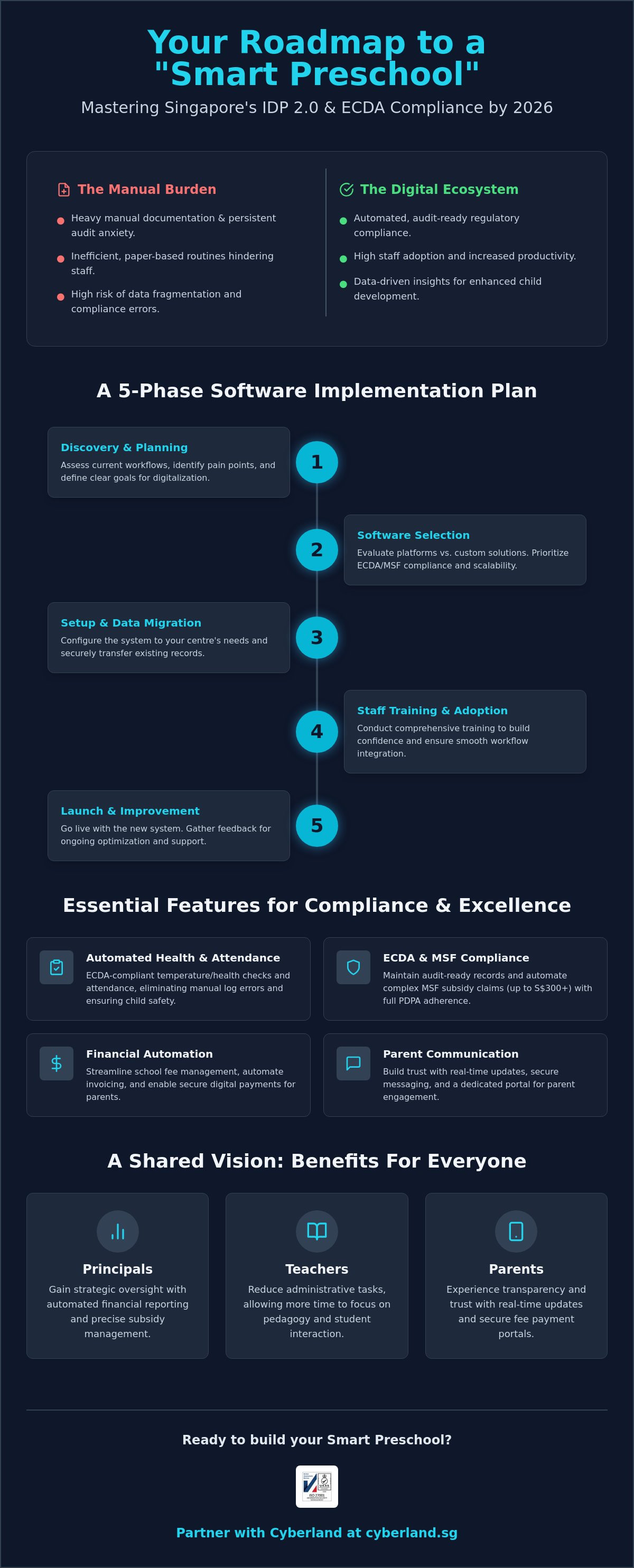
A successful transition to a digital ecosystem is rarely about the software alone; it's about the precision of the transition process itself. To avoid operational paralysis, a preschool software implementation plan singapore centres adopt must be methodical, moving from high-level strategy to granular execution. This phased approach ensures that your centre maintains its commitment to child care quality while upgrading its administrative backbone. By treating the implementation as a series of manageable milestones, you can mitigate the risks of data loss and staff burnout.
Phase 1: Internal Audit. Begin by documenting your current manual bottlenecks with absolute honesty. This involves identifying exactly how many hours your staff spends on paper-based portfolios or manual fee reconciliation. Phase 2: Requirement Mapping. Once the gaps are identified, use a feature checklist to define your "must-haves." This ensures you prioritize ECDA-compliant health tracking and MSF subsidy automation over secondary aesthetic features. Clear mapping prevents the "scope creep" that often delays digital projects.
Phase 3: Vendor Vetting. Assess potential partners not just on their software, but on their local support reliability and regulatory expertise. Phase 4: Pilot Deployment. Test the system with a small group of "power users," such as your Senior Teachers or administrative leads. This allows you to refine workflows in a controlled environment before a centre-wide launch. Phase 5: Full Integration. Execute a phased rollout that respects the school calendar, avoiding peak periods like the start of a new term or major holiday programs. This steady pace fosters a sense of stability and confidence across the entire team.
Vetting Your Technology Partner
Stability is a non-negotiable requirement in the Singaporean educational sector. When evaluating a vendor, look for a proven history of navigating local regulatory shifts, such as the transition to IDP 2.0 standards. The right partner provides more than just a login; they offer comprehensive onboarding support tailored to non-technical staff. As your centre expands or adds new branches, the software must scale without requiring a complete system overhaul. For a solution built on two decades of local expertise, consider how our PreSchool Management System can serve as your long-term digital foundation.
Driving Successful Staff Adoption
The true measure of a successful implementation is the adoption rate among your educators. If the interface feels cumbersome, teachers will view it as an additional burden rather than a tool for efficiency. Success depends on an intuitive, user-friendly interface that simplifies their daily tasks. Create a training schedule that respects their existing workloads, perhaps utilizing "bite-sized" learning sessions. Establishing a transparent feedback loop immediately after launch allows you to address technical friction points before they become ingrained frustrations. When staff see that the system genuinely reduces their "administrative tax," they become the strongest advocates for the new digital culture.
Cyberland and BridgED: Your Partners in Digital Excellence
For over two decades, Cyberland has served as a cornerstone of Singapore's software consultancy landscape, providing steady guidance to institutions navigating the complexities of technological change. We approach each partnership with a sense of quiet confidence, rooted in a deep understanding of the early childhood sector's unique demands. We don't view ourselves as mere vendors; we're mission-driven bridge-builders dedicated to the long-term success of the centres we serve. By choosing an established partner, you ensure that your preschool software implementation plan singapore is backed by a veteran team that values precision, heritage, and regulatory discipline.
Our role is to simplify the transition from legacy manual processes to a sophisticated digital ecosystem. This transition requires more than just technical installation; it demands a partner who understands the earnest responsibility of community care and education. We provide the stability needed to modernize your operations without sacrificing the human connection that defines your centre. This commitment to reliability ensures that your administrative foundation remains secure as you scale your impact across the Singaporean community.
The BridgED Platform Advantage
Positioned as the professional platform of choice for local centres, BridgED offers a comprehensive suite of capabilities designed for the 2026 regulatory environment. Our PreSchool Management System integrates attendance tracking, digital student portfolios, and parent communication into a single, intuitive interface. It's specifically engineered to meet the 5th Edition ECDA Code of Practice standards, ensuring that your record-keeping is always audit-ready. For a local childcare group we recently supported, the implementation of BridgED reduced their administrative overhead by providing a unified source of truth for MSF subsidy management and student health data. This level of integration allows educators to shift their focus back to classroom pedagogy and child development milestones.
Custom Solutions for Complex Institutional Needs
While standard platforms serve many, some institutions require a more tailored approach to support their specific educational philosophies or large-scale operational structures. Our Custom Software Development services allow you to build bespoke modules that integrate seamlessly with your existing workflows. We focus exclusively on software excellence and user experience, ensuring your digital tools are optimized for performance without the distractions of hardware management. This focused expertise allows us to solve specific operational hurdles, such as unique curriculum mapping or complex financial reporting across multiple branches. Partnering with us means investing in a stable, sophisticated digital strategy that supports your institutional growth for years to come.
Securing Your Centre's Digital Future in 2026 and Beyond
Transitioning to a digital-first administrative model is a strategic necessity for preschools aiming to thrive under the IDP 2.0 framework. By following a structured preschool software implementation plan singapore operators can effectively bridge the gap between manual inefficiencies and automated, paperless workflows. This journey requires a focus on stakeholder alignment and a deep respect for teacher workloads to ensure high adoption rates across your team. Successfully navigating these shifts allows your educators to focus on their primary mission of classroom pedagogy rather than administrative documentation.
Since 2002, Cyberland has provided sophisticated software solutions rooted in a thorough understanding of local regulatory standards. Our BridgED platform is specifically engineered to navigate the complexities of ECDA audits and MSF subsidy management, providing the stability your institution deserves. With over two decades of local software expertise, we act as a dependable mentor through every phase of your modernization. We invite you to consult Cyberland for a tailored preschool management solution that aligns with your unique educational philosophy. Embracing this modernization today ensures your centre remains a leader in nurturing the next generation with precision and care.
Frequently Asked Questions
What is a preschool management system, and why is it essential in Singapore?
A preschool management system is a centralized digital platform that integrates a centre's administrative, financial, and pedagogical workflows into a single hub. In Singapore, it's essential for navigating the complex regulatory environment, especially with the 2026 5th Edition ECDA Code of Practice. These systems automate the tracking of student health, attendance, and MSF subsidies, which are increasingly difficult to manage manually as standards for operational efficiency and data security continue to rise.
How does a management system ensure my centre stays ECDA compliant?
Digital management systems maintain compliance by automating the rigorous record-keeping required by the Early Childhood Development Agency (ECDA). These platforms capture real-time data for health checks and attendance, ensuring that all logs are accurate and audit-ready for licensing renewals. By digitizing student portfolios and aligning them with the Nurturing Early Learners (NEL) framework, centres can demonstrate their commitment to pedagogical standards with professional precision and transparency.
Can I apply for the PSG grant to implement preschool software in 2026?
Yes, eligible centres can apply for the Early Childhood Digitalisation Grant (ECDG) under the Productivity Solutions Grant (PSG) framework in 2026. This grant provides funding for up to 50% of implementation costs for pre-approved digital solutions. Additionally, the SkillsFuture Enterprise Credit (SFEC) may offer a one-off S$10,000 credit to offset up to 90% of out-of-pocket expenses for supportable programs, provided applications are submitted before the scheme's expiration on November 30, 2026.
How long does a typical preschool software implementation take?
A typical preschool software implementation plan singapore centres execute usually spans between four to twelve weeks, depending on the complexity of the centre's operations. This timeframe includes the initial internal audit, requirement mapping, and the training of educators to ensure high adoption rates. A phased rollout is often the most effective way to minimize disruption to the school calendar while allowing staff to become proficient with the new digital ecosystem.
What are the main differences between off-the-shelf and custom preschool software?
Off-the-shelf software provides a standardized set of features designed for the general market, while custom software development allows for bespoke modules tailored to unique educational philosophies. Standard SaaS platforms like BridgED are ideal for centres seeking a reliable, pre-approved solution for core administrative needs. Custom engineering is better suited for institutions with complex curriculum requirements or those needing to integrate with specific legacy databases used by larger corporate groups.
Is it difficult to migrate our existing paper records to a digital system?
Migrating paper records to a digital system is a methodical process that's highly manageable when approached with a structured plan. The transition involves digitizing student files, financial records, and historical health data to create a single source of truth. Most centres find that a phased migration, starting with the current enrollment cycle, reduces the immediate workload and ensures that data integrity is maintained throughout the digital transition.
Does Cyberland provide hardware along with the software licensing?
Cyberland focuses exclusively on delivering software excellence and doesn't provide hardware sales as part of our licensing agreements. This approach allows us to specialize in the development of sophisticated platforms like BridgED without the overhead of hardware maintenance. Centres are encouraged to select their own tablets or computers that best fit their specific classroom environments and budget, ensuring their digital infrastructure is fully customized to their needs.
What kind of technical support is provided during the digital transition?
We provide comprehensive onboarding, staff training, and ongoing technical assistance to ensure a smooth transition to your new system. Our team acts as a dedicated mentor, guiding you through the initial setup and helping educators overcome any technical friction points. While we don't offer 24/7 on-site emergency support, our professional support desk is available to address queries and maintain the stability of your digital administrative hub.


Comments